Otawalle Grand Exodus
The Deer KingThe Otawalle Grand Exodus was a mass flight from a capital devastated by black wolf fever, remembered both as an attempt to save the uninfected and as the political break from which the Kingdom of Aquafa emerged. Under Takaluhalu, the last king of Otawalle, the capital was abandoned, isolated from the mainland, and ultimately replaced by Kazan as the seat of rule. The episode’s stark choice—who would be led to safety and who would be left behind—echoes later imperial systems that classified and relocated whole populations.
Plague and the Decision to Flee
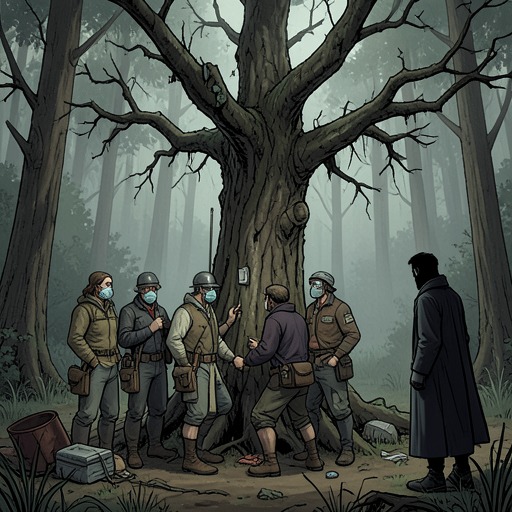
Hohsalle recounts the exodus while explaining a disease that began in the capital’s poorest districts during a hot, muggy summer. Residents there lived crowded together, and the illness spread outward through the city. Physicians of the Academy of Deeper Learning suspected a chain of transmission from wolves to the fleas and ticks that fed on them, and then to rats. By the time officials began exterminating rodents and pests, thousands had died.
The response was not to eliminate the disease within the city, but to abandon the capital. When Yotalu asks whether this was the occasion on which the Grand Edict of the Exodus was issued, Hohsalle confirms that the tale belongs to that period. The crisis thus became more than an outbreak: it demanded a political decision to divide the population between those taken away and those left behind.
The Abandoned Capital
Takaluhalu deserted a capital that had prospered for a thousand years. Otawalle’s principal cities stood on three islands in a large inland sea. Their position had offered strong defense against invasion, but Hohsalle says the enclosed environment was also thought to have contributed to the plague’s lethality. In the same geography lay a means of containment: the king left the sick and those who refused to leave, destroyed the long bridge connecting the capital to the mainland, and abandoned them in an effort to save those not infected.
The ancient records describe the departure of the pale-skinned Otawalle in a manner Hohsalle calls farcical: they removed their clothes, shaved their body hair, and crossed the bridge in single file, weeping. The manner of their flight does not soften its cost. The people who remained behind met a cruel end, making the spectacle of escape inseparable from the lives it could not save.
A Kingdom Founded by Flight
After turning away from his people, Takaluhalu moved the capital to Kazan, a trading city that had miraculously escaped the plague. He then relinquished his crown to Kazan’s young ruler. Hohsalle presents this transfer as the birth of the Kingdom of Aquafa: it arose from the flight from black wolf fever, not from a victorious conquest or a peaceful succession. The founding story therefore carries a double inheritance, political renewal purchased through abandonment and a new kingdom established by a ruler who no longer claimed the crown.
Hohsalle also identifies a limited form of salvation in the history. The disease, he says, does not pass from person to person, and its symptoms manifest very quickly after an infected person or animal is bitten by an animal. The account of the exodus thus functions as both a record of devastation and a lesson about transmission: the knowledge gained from disaster can inform later efforts to understand and contain the disease.
Flight and the Management of Populations
The exodus provides a historical counterpoint to the later rule of Zol. Aquafa had allied itself with the invaders and become an imperial province, securing ordinary-citizen status for its people. The mountain clans of the Toga region, despite speaking Aquafa’s language and having defended its borders, were not recognized as Aquafaese citizens. Under the former king they had retained loose autonomy in exchange for allegiance; under Zol, their status was determined by imperial frontier policy.
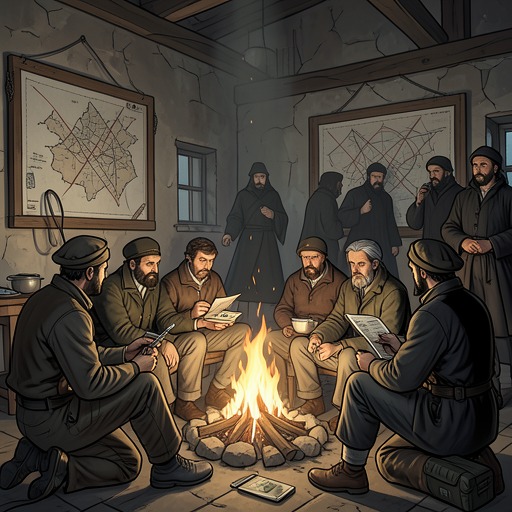
Zolian policy relocated lower-caste people to other conquered territories. Facing the prospect of expulsion, Gansa leaders planned a show of resistance in the hope that the empire would instead permit their people to stay as useful allies and a buffer against Mukonia. In a later frontier settlement policy, poor farmers and herders from the edges of the Zolian realm were ordered to move into conquered lands, build communities in the Zolian manner, and raise the crops and livestock favored by the empire. Lower taxes and ownership of cleared farmland offered material advantages to some settlers, but they could still grieve the loss of their homeland. Across these distinct episodes, flight and relocation are not simply movements between places: they are decisions made under the pressure of disease, conquest, and the state’s power to sort populations and reshape territory.